Martin Bormann - Nazi in Exile by Paul Manning
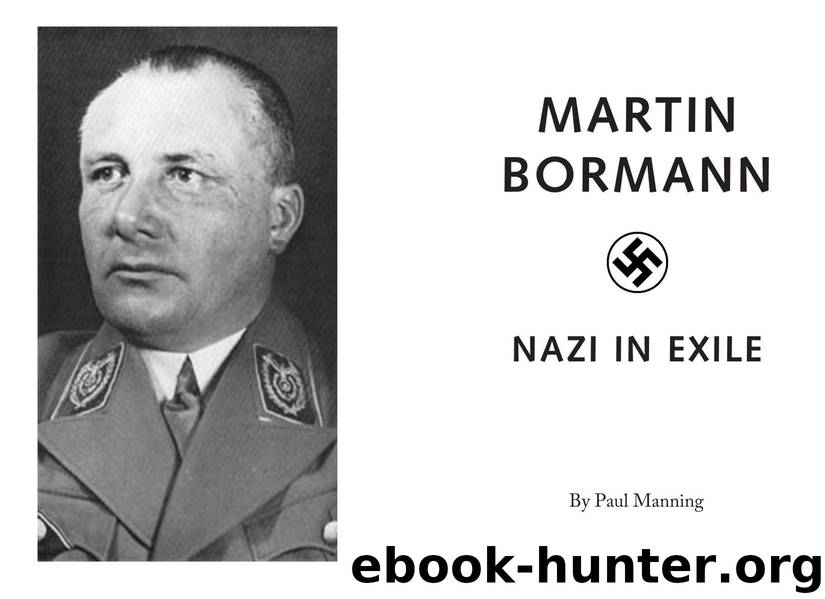
Author:Paul Manning
Language: eng
Format: mobi
Published: 0101-01-01T00:00:00+00:00
of aggression were no more unprepossessing than their Allied counterparts might have been had they lost the war and found themselves awaiting trial and sentencing. Leadership on both sides was represented by educated academics, administrators, and military notables who saw to it that the war kept moving along. Still, Nuremberg was a landmark, and if it did not halt the proliferation of wars it reinforced the international principle that there are standards of human behavior all nations should adhere to.
As the first trial was concluded, with sentences pronounced and carried out on the 21 defendants, the twenty-second was stirring in his bolthole. Martin Bormann had been moved from Schleswig-Holstein to a safe house in Denmark by his security chief, Heinrich Mueller. The party minister had been tried in absentia at Nuremberg; while found not guilty on charges of crimes against peace, for he had not been one of the early plot-ters of war, he had been found guilty as charged of war crimes and crimes against humanity. Bormann believed he was not guilty on any of the counts; but he also knew that disappearing was the only course, else he too would have been hanged until dead in the gymnasium of Nuremberg prison.
Martin Bormann became the object of history’s greatest manhunt. At least one thousand Allied intelligence officers, representing Great Britain, the United States, France, and Russia, were on his trail, together with an uncounted number of informers who coveted the reward offered for information leading to his capture. But Heinrich Mueller had strung an invisible, impenetrable defense between Bormann and those who sought him. Select units of the Gestapo continued to function, unofficially, and those who now reported directly to Mueller, under suspicion of surviving Berlin and therefore also a subject of search, were among the best secret police agents of the SS. Out of uniform, they continued to draw pay and expenses from their paymaster, representing Mueller, from SS funds held in a numbered account in a Swiss bank. As the search for Bormann went from hot to cold to hot, Mueller continued to move the Party Minister around, back and forth between Schleswig-Holstein and Denmark, but staying clear of major cities such as Hamburg.
Mueller had a network of loyal informers, SS men who had reHans Bernd Gisevius giving testimony at the Nuremberg trials. Gisevius, turned to their peacetime positions on German police forces at a leader of the German underground during World War II, was also a double agent for the OSS. He was Allen Dulles’s pipeline to Admiral 192
Canaris, chief of the German Foreign Intelligence Service (Abwehr) until 1944 who himself served as a high level British informer during most of the Second World War.
Download
This site does not store any files on its server. We only index and link to content provided by other sites. Please contact the content providers to delete copyright contents if any and email us, we'll remove relevant links or contents immediately.
| Africa | Americas |
| Arctic & Antarctica | Asia |
| Australia & Oceania | Europe |
| Middle East | Russia |
| United States | World |
| Ancient Civilizations | Military |
| Historical Study & Educational Resources |
Cecilia; Or, Memoirs of an Heiress — Volume 1 by Fanny Burney(32637)
Cecilia; Or, Memoirs of an Heiress — Volume 2 by Fanny Burney(32011)
Cecilia; Or, Memoirs of an Heiress — Volume 3 by Fanny Burney(31997)
The Secret History by Donna Tartt(19310)
Sapiens: A Brief History of Humankind by Yuval Noah Harari(14464)
Leonardo da Vinci by Walter Isaacson(13412)
The Radium Girls by Kate Moore(12095)
Sapiens by Yuval Noah Harari(5412)
How Democracies Die by Steven Levitsky & Daniel Ziblatt(5274)
The Wind in My Hair by Masih Alinejad(5140)
Homo Deus: A Brief History of Tomorrow by Yuval Noah Harari(4964)
Endurance: Shackleton's Incredible Voyage by Alfred Lansing(4847)
Man's Search for Meaning by Viktor Frankl(4674)
The Silk Roads by Peter Frankopan(4588)
Millionaire: The Philanderer, Gambler, and Duelist Who Invented Modern Finance by Janet Gleeson(4539)
The Rape of Nanking by Iris Chang(4264)
Joan of Arc by Mary Gordon(4157)
The Motorcycle Diaries by Ernesto Che Guevara(4151)
Stalin by Stephen Kotkin(4007)
